
In the world of training there are just a few principles for health and fitness that guide people to improve their physical fitness. In this article I will list and describe the five principles of exercise training.
The principles of exercise training are as follows:
- Overload principle
- Principle of progression
- Principle of specificity
- Principle of recuperation
- Principle of reversibility
Overload Principle:
The overload principle is a key component of all conditioning programs, because to improve fitness, the muscular and cardiorespiratory systems of the body must be stressed. Overload can be achieved in multiple ways, be either increasing intensity, time, or weight.
Some examples of the overload principle would be working a muscle longer by increasing the number of repetitions, holding a stretch for a longer period of time, or stretching the muscle to a longer length.
Overload does not mean to engage in painful or exhausting workouts!
Principle of Progression:
The principle of progression is really an extension of the overload principle. The progression principle means to gradually increase the overload over the course of an exercise program. For the first 1-6 weeks of a program the progression should be slow and gradual. The next 6-20 weeks should be a steady progressive increase.
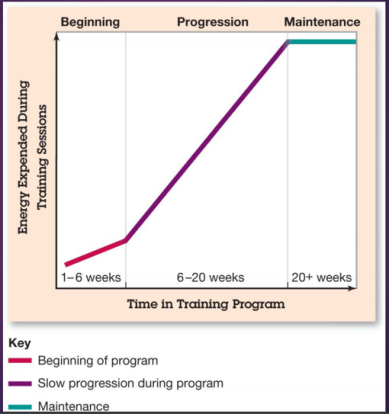
Once you have reached your desired fitness level or goal, you should develop a maintenance program to sustain the benefits. You can also set a new goal and develop a plan for that.
There is one rule to the principle of progression, that is the Ten Percent Rule. The Ten Percent Rule is a guideline to improve physical fitness without injury. It states that training intensity or exercise duration should not be increased by more than 10% per week.
Principle of Specificity:
The principle of specificity states that exercise training effect is specific to those muscle involved in the activity. For example, performing leg curls will not benefit your upper arms. This principle underscores the importance of varied exercises and overall fitness improvement. This also applies to the types of adaptations that occur in the muscle, meaning strength training will not greatly improve muscular endurance.
Principle of Recuperation:
The principle of recuperation states that you need to let your body rest, after all that is how the muscle grows. To achieve the maximal benefit from exercise it is recommended to have at least 24 hours of rest in between workouts. Failing to properly rest your body can lead to overtraining. Overtraining can lead to chronic fatigue, increase the risk of infection, and injuries. The remedy for overtraining is to increase the period of rest between session, or reduce the intensity of the workouts, or both.
Principle of Reversibility:
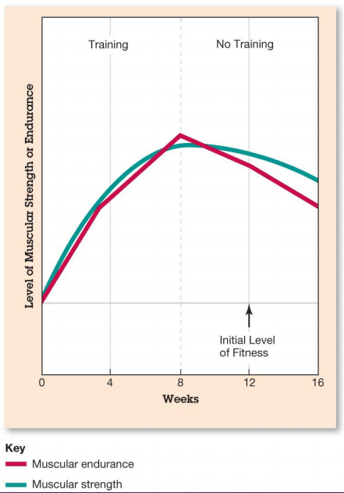
The principle of reversibility means that if you don’t use it you lose it. There is a decrease in your fitness level due to inactivity. This principle also applies if you go too long between exercise sessions or have an inconsistent routine. The speed at which fitness is lost depends on the nature of the exercise. For example if you stop strength training the result will be a slow, gradual loss of muscular strength. Stopping endurance related exercise will result in a relatively swift loss of endurance.
Summary:
- Gradually increase weight, distance, time
- Do exercises to target what you want to improve
- Give your body time to rest so you can grow and avoid injury
- Have a consistent plan
- Stay active
 KRAM LIFE
Leave a comment