
A highly sought after goal is strength and how many times you can rep an extraordinary amount of weight. People look at the famous bodybuilders like Arnold Schwarzenegger, Jeremy Buendia, or even Calum Von Moger, and think “Wow, I want to look like them.” And, they hit the gym with no idea what they are doing. Even the Olympia champions started somewhere, and it took them years to achieve their strength and physique. Again, fitness is a long, never-ending journey and nothing happens overnight. You need to have patience and determination and you will reach your goals.
Why should you improve muscular strength:
You might be reading this and thinking, “Why do I need to improve my strength, I am basically Hercules.” Well, here’s your answer: improving your muscular strength has more benefits than being able to lift heavy objects. First of all, when you improve your overall strength, it is going to reduce lower back pain. Also, if you are already an active person, it is going to help reduce joint and muscle-related injuries that come from physical activity. More importantly, it is going to help prevent osteoporosis, which means your bone density will increase. Lastly, it is going to increase your resting energy expenditure, also known as your resting metabolic rate. Read “Weight Loss Explained” to figure out your BMR.
Muscular Strength:
So what is muscular strength? Muscular strength is the amount of force a muscle can generate based on:
- Size of the muscle (the larger the muscle, the greater the force produced)
- Number of muscle fibers recruited during a movement (the more fibers that are stimulated = the greater the force generated)
Before you can dive into strength training, you need to assess yourself. That way, you know where you are starting and you can see your progress week after week. The best way to measure strength is to do a one-repetition maximum test (1RM). This will measure the maximum amount of weight that can be lifted one time. This is recommended for experienced lifters only though.
For beginners, you can accurately estimate your 1RM with 1RM calculators. You just type in the weight lifted and how many times you lifted it. The further you get from 1, the less accurate. Do not use more than 10 reps.
The exercise principles that go into a strength program are progressive overload and specificity. Read more about exercise principles in this article: “Principles of Exercise.”
The Formula:
The formula for increasing strength is quite simple, it is this:
- High resistance + low reps
All this means is that to gain strength you need to lift heavy. Typically, to build strength you stay around 8 reps. I personally used to do 5×5 (5 sets of 5 reps) on bench press, deadlifts, and squats, and I saw a tremendous increase in strength.
Typically, the frequency for strength training is 2-3 days per week, which is optimal for strength gains. It is considered optimal because your body needs more rest when you are strength training.
Programs that involved 3 sets resulted in the greatest strength gains, but everyone is different, so find what is comfortable for YOU, and reap the rewards.
Also, the number of reps can be different for everyone, but research shows that 8 reps per set saw the greatest increase in strength. Again, do what is comfortable for you.
To see the most strength gains, you are going to need to do mainly compound lifts. A compound lift is also known as a multi-joint movement, meaning that more than one joint is moving during the lift.
Examples of compound movements:
- Chest:
- Bench press (barbell, dumbbell, machine)
- Incline press (barbell, dumbbell, machine)
- Decline press (barbell, dumbbell, machine)
- Dips (wide grip)
- Back:
- Pull-ups
- Lat pulldowns
- Rows (barbell, dumbbell, machine)
- Deadlift (conventional, sumo, hex-bar)
- Legs
- Squat (back squat, front squat, box squat)
- Lunges (barbell, dumbbell)
- Leg press
Phases:
Starter Phase: 1-3 weeks Lighter weights, more reps. Twice a week
Slow progression phase: 4-20 weeks Heavier weights, fewer reps. Increase frequency 2-4 times per week
Maintenance phase: Starts around 20 weeks Requires a long-term commitment to maintain gains. As little as one workout a week can maintain strength
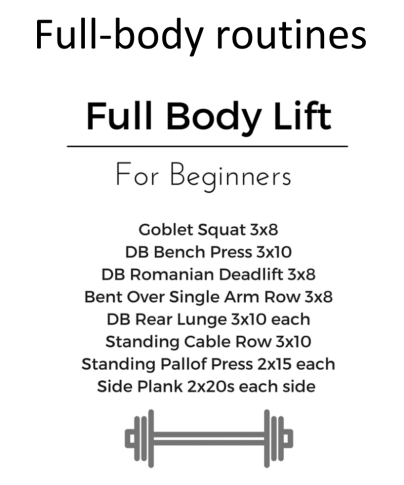
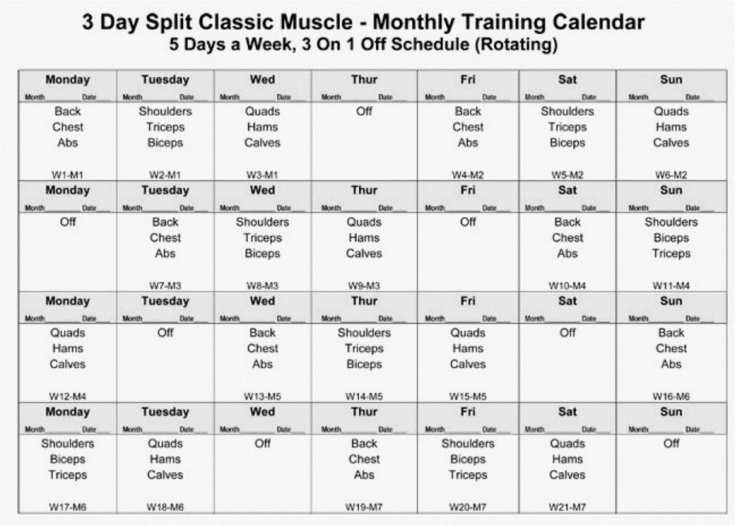
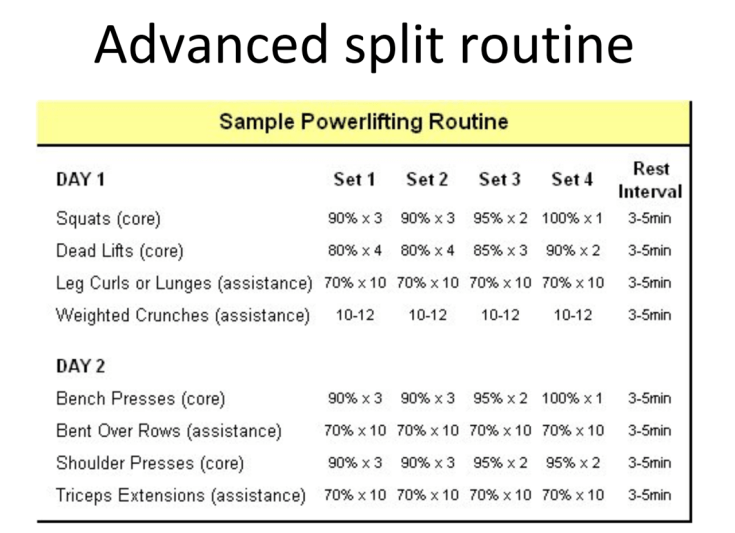
Example Routines:
Safety concerns:
When lifting heavy weights, there is always the worry of dropping that weight on yourself, so it is important to always use a spotter and/or safety rails. Another thing that people overlook is the use of collars, which keep the weight from sliding off if you lose balance, be sure to use them. Resist the temptation to drop the weight, because there’s a chance it will fall on your foot and you’ll be out of the gym for weeks. It is also crucial to do a warm-up before lifting, it will also help with increasing the amount of weight lifted. People tend to forget to breathe when lifting heavy, but breathing through the exercise will actually help performance, plus your face won’t turn all red and purple. Finally, put your ego aside and start with lighter weights and gradually work your way up.
Summary:
- Strength takes time to build
- Use mainly Compound Movements
- Choose a routine that is right for you/ fun
- Follow all safety concerns
- Strength = High resistance + low reps
- Strength improves many daily activities
- Strength training has 3 phases: beginner, slow progression, maintenance.
 KRAM LIFE
Leave a comment